









Travel Adapter Guide: Do You Need One? (Yes)
A universal travel adapter is a £15 problem. Buy one before you go, not at the airport where they're £45 and identical.
There are over fifteen socket types in the world. Your UK three-pin plug works in about four countries. A good universal adapter covers all of them, has built-in USB ports, and fits in the palm of your hand. Buy it once, pack it permanently, never think about it again.
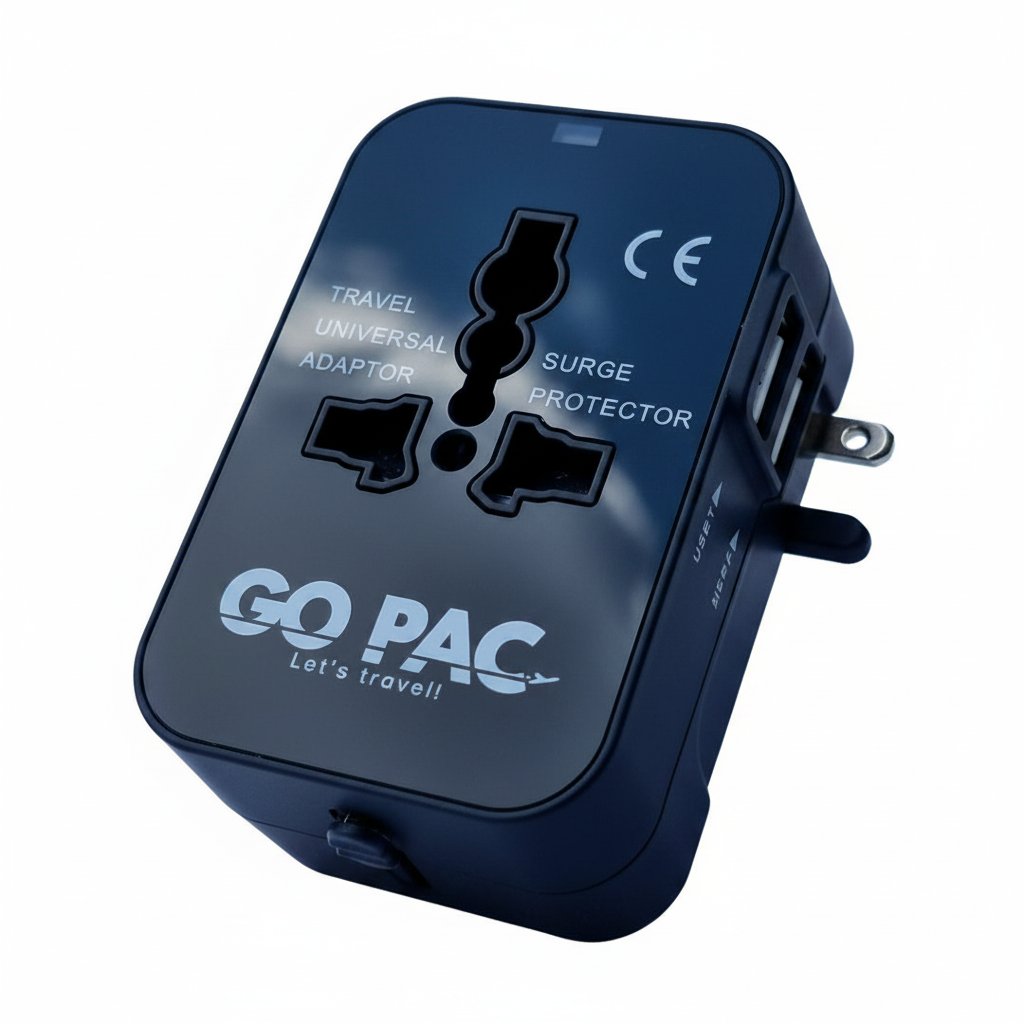
The one we make GO PAC
We wrote this guide because we got tired of the 1am hotel panic, then we made the adapter we wanted to own. It covers 150+ countries, has USB-A and USB-C built in so the phone, the watch and the earbuds share one socket, and it has the surge protection the cheap ones leave out. It is the same £15 the article above says you should spend, and we would rather you spent it with us. If you would rather shop around, the Amazon picks below are genuinely fine.
View the GO PAC adapter, £14.99 ✦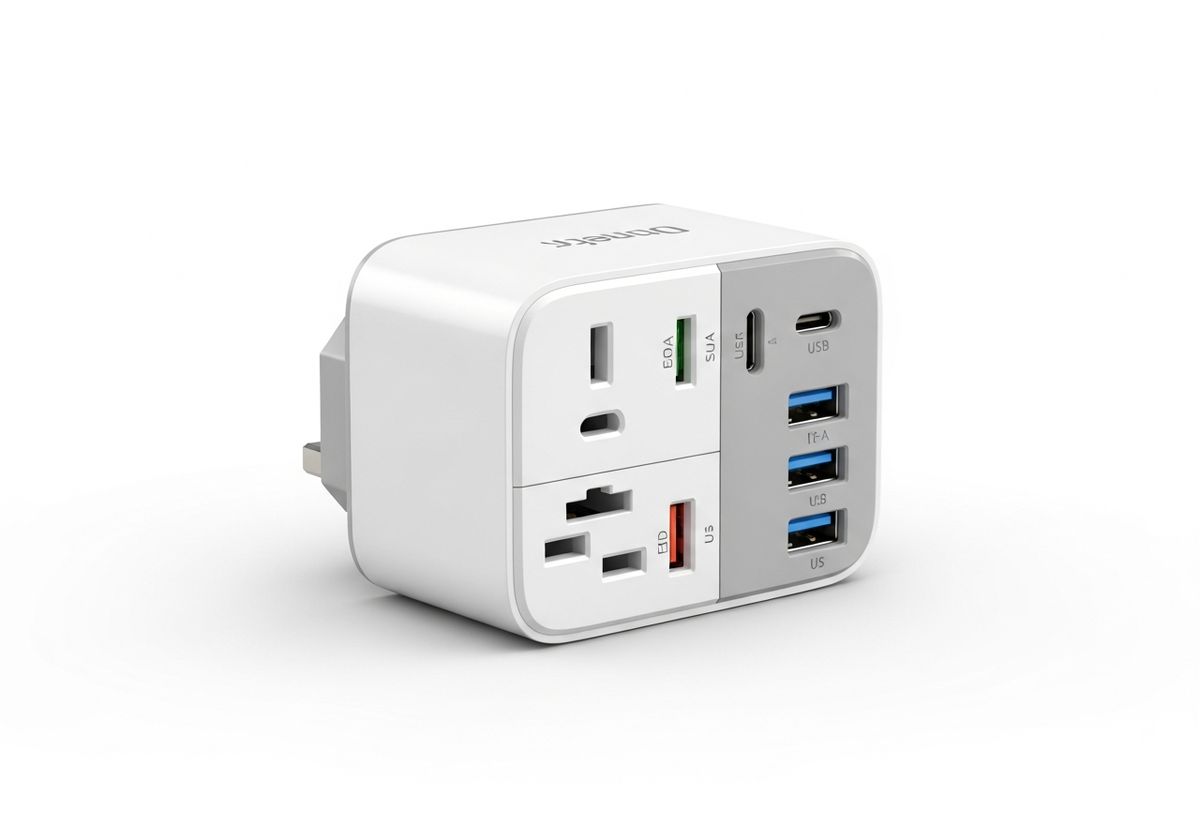
A good universal adapter is roughly the size of a large ice cube. It covers every major plug type and has USB ports built in.

One wall socket, three devices. A universal adapter with multiple USB ports means you're not playing musical chargers all evening.

Pack it once, leave it permanently in your travel bag. The day you don't need it is free. The day you do and don't have it is memorable for all the wrong reasons.
The 1am hotel panic that explains this entire article
You've just landed after a long-haul flight. It's past midnight. You've navigated a new city's public transport with luggage, finally found the hotel, and collapsed on the bed with your phone at 4% battery. You reach into your bag for your charger, plug it in, and nothing happens. You look at the wall socket. You look at your UK plug. They are incompatible in every possible way.
This has happened to almost everyone who travels internationally more than once. And it is entirely, 100% avoidable with a single item that costs less than a round of drinks.
"You will not find a better use of £15 in your travel prep than a universal adapter bought before the airport." GO PAC team, veteran of the 1am socket panic
Why socket types actually matter
There are more than fifteen different socket types in use around the world. Not slight variations -- completely different shapes, pin configurations, and sometimes voltages. As a UK traveller, you're starting with a Type G plug: the large three-prong rectangular design. It's remarkably safe, notably bulky, and almost exclusively used in the UK, Ireland, Malta, and a handful of former British territories. Almost nowhere else.
In mainland Europe, you'll mostly find Type C (two round pins) or Type F (two round pins with earth contacts on the side). In the USA, Canada, and Japan, it's Type A (two flat parallel pins). In Australia and New Zealand, Type I (two or three flat pins in a V shape). Each of these is physically incompatible with UK plugs. You cannot force one into the other. You simply cannot charge your phone without the right adapter.
Always weigh your bag at home before you leave, every airline's carry-on limit is different, and the gate scale is the worst place to find out yours is over.
What to look for in a good travel adapter
Not all travel adapters are created equal. The cheap white-label ones at the bottom of Amazon search results are worth actively avoiding. They can overheat, they often lack surge protection, and the socket connections can be loose enough to be unreliable. When your phone is your map, your boarding pass, and your bank card, a dodgy adapter is a genuine problem.
USB-C PD (Power Delivery) port. If you have a modern phone, laptop, or tablet, you probably charge it via USB-C. An adapter with a built-in USB-C PD port means you don't need to carry a separate charger for USB-C devices. The most important feature to check for in 2026.
Surge protection. Power supplies abroad are not always as stable as in the UK. Surge protection means a spike in the mains won't fry your laptop. It's cheap to include in manufacture and a sign of a quality product.
Multiple USB ports. A good universal adapter will have at least two USB-A ports and one USB-C port built in, letting you charge several devices simultaneously from one wall socket.
Our own GO PAC Travel Plug Adapter ticks every box above at £14.99 with free UK shipping. If you would rather compare, browse universal adapters on Amazon.
How a good universal adapter rates
Are you an adapter disaster?
Find out what kind of travel packer you really are
Where is your travel adapter right now?
Have you ever arrived somewhere without a working adapter?
What does your current adapter cover?
Pack one outfit you can re-wear: dark colours, quick-dry, no logos. It's your "things went sideways" backup and it weighs almost nothing.
Universal adapter vs country-specific adapters
✓ Universal adapter with USB
- Covers every destination in one unit
- USB-C and USB-A built in -- no separate charger
- Buy once, pack it permanently
- Surge protection on quality models
- Charge multiple devices from one socket
✗ Country-specific adapters
- Need a different one for every destination type
- No built-in USB -- still need separate chargers
- More items to remember, more to lose
- Usually no surge protection
- One socket, one device
What to look for in a travel adapter
✦ Adapter buying checklist
Frequently asked questions
The four most useful types for UK travellers: Type A and B (two or three flat pins) -- USA, Canada, Japan, Mexico, Central America, most of the Caribbean. Type C and F (two round pins) -- almost all of mainland Europe, South America, and large parts of Asia and Africa. Type G (UK three-pin) -- UK, Ireland, Malta, Hong Kong, Singapore, Malaysia, parts of the Middle East. Type I (angled flat pins) -- Australia, New Zealand, Argentina, Papua New Guinea. A universal adapter covering all of these handles roughly 95% of all international travel destinations.
Yes -- despite being geographically close, European countries use Type C or Type F sockets (two round pins), which are physically incompatible with UK three-pin plugs. If you only ever go to Europe, a simple, cheap UK-to-two-pin adapter is all you need and they're tiny. But if you occasionally go further afield, a universal adapter is the smarter long-term buy -- it handles Europe and everywhere else, and the price difference is minimal.
Both, ideally. USB-C is now the standard for modern phones (all iPhones since the 15, most Android flagships, MacBooks, iPads) and charges them faster -- look for USB-C PD (Power Delivery) support, which enables the fastest charging speeds. USB-A is the older rectangular port, still needed for older devices, some cameras, some Kindles, and older cables. A good universal adapter has at least one USB-C and two USB-A ports built in. This means you can charge your phone, your partner's phone, and an older device from one wall socket without bringing any individual charger bricks.
A travel adapter only changes the physical shape of the plug -- it does not convert voltage. The USA runs on 110-120V; the UK runs on 230-240V. Using a US-voltage appliance in a UK socket (or vice versa) without a voltage converter will either damage or destroy the appliance. The good news is that most modern electronics -- phones, laptops, cameras -- are dual-voltage (look for "Input: 100-240V" on the charger brick) and work on any mains supply without a converter. The exceptions are cheap single-voltage appliances like some hair dryers, straighteners, and older kitchen items. Always check the label before plugging in abroad.
For universal travel adapters, BESTEK, Epicka, and LENCENT consistently receive strong reviews for build quality, surge protection, and USB port performance in the £15--£25 range. Anker makes excellent USB-focused charging solutions but their travel adapters sit at a higher price point. The key criteria over brand name: surge protection explicitly mentioned, USB-C PD for fast charging, compact build, and genuine customer reviews that mention durability over multiple trips. Anything with no brand name at suspiciously low prices -- avoid. The slight premium on a quality adapter is worth it given what it's protecting.
A good universal adapter with USB-C and USB-A ports costs £12--£20. It covers every major plug type worldwide. Buy it before your next trip, put it in your travel bag, and never take it out. Browse on Amazon → (Amazon Associate link)