Travel adapter UK: which plug you need, by country
A travel adapter changes the shape of your plug. It does not change the voltage.
That one distinction causes most of the trouble people have with electricals abroad. Phone and laptop chargers are almost always fine anywhere. Hairdryers, straighteners and travel kettles are where things go wrong, and an adapter on its own will not save them.
What a travel adapter actually does
An adapter is a shape converter. It lets a UK three pin plug physically fit a socket that was built for a different shape. Nothing more.
Electrical Safety First's guidance is that if the supply voltage is different, a voltage transformer or converter is needed unless the electrical appliance, or its power supply, is dual voltage rated. A dual voltage appliance shows an INPUT marking, for example INPUT: 110-240V, on the body of the appliance or on its power supply, meaning it will work with any supply between 110V and 240V. You can read the full guidance on using electricals overseas.
In practice that means most of what you carry is fine. Phone chargers, laptop chargers and camera chargers are usually dual voltage, because the manufacturer builds one power supply for every market. Check the small print on the plug body before you assume it.
Which plug type you need
Plug shapes are grouped by letter. Every country below is listed with the plug types Electrical Safety First states for it, with a link to the page that says so. All checked on 25 September 2026.
| Country | Plug type | Source |
|---|---|---|
| United Kingdom | Type G | ESF |
| Ireland | Type G | ESF |
| Malta | Type G | ESF |
| Cyprus | Type G | ESF |
| Singapore | Type G | ESF |
| Hong Kong | Type G | ESF |
| United Arab Emirates | Type G | ESF |
| France | Type C and E | ESF |
| Germany | Type C and F | ESF |
| Spain | Type C and F | ESF |
| Portugal | Type C and F | ESF |
| Greece | Type C and F | ESF |
| Netherlands | Type C and F | ESF |
| Italy | Type C, F and L | ESF |
| United States | Type A and B | ESF |
| Canada | Type A and B | ESF |
| Mexico | Type A and B | ESF |
| Japan | Type A and B | ESF |
| Australia | Type I | ESF |
| New Zealand | Type I | ESF |
| Argentina | Type I | ESF |
| China | Type A, C and I | ESF |
| India | Type C, D and M | ESF |
| South Africa | Type C, M and N | ESF |
Two things worth noticing in that table. Several countries have more than one plug type in use, so "one adapter covers it" is doing some work. And a UK Type G plug already fits Ireland, Malta, Cyprus, Singapore, Hong Kong and the UAE, so you may not need an adapter at all.
If your destination is not listed, Electrical Safety First has a page for it. Check the socket type and the supply voltage, because the second one decides whether your appliance works at all.
Hairdryers, straighteners and other high wattage appliances
This is the section worth reading twice, because it is where adapters get blamed for damage they did not cause.
A heating appliance draws far more power than a charger. Electrical Safety First advises checking that the appliance does not exceed the maximum power rating, shown in amps or watts on the adapter. Adapters are not all rated the same, so check the rating on the adapter itself.
Two things have to be true before you plug a hairdryer in abroad:
- The appliance is dual voltage rated for the country you are visiting. Check the INPUT marking on the appliance or its power supply, as above. If it does not cover the local supply voltage, an adapter will not make it safe to use.
- The appliance sits within the adapter power rating. Check the amps or watts marked on the adapter against the appliance.
If either is not true, you need a voltage transformer or converter rather than an adapter, or the far simpler answer: use the hotel hairdryer and leave yours at home.
The GO PAC travel plug adapter
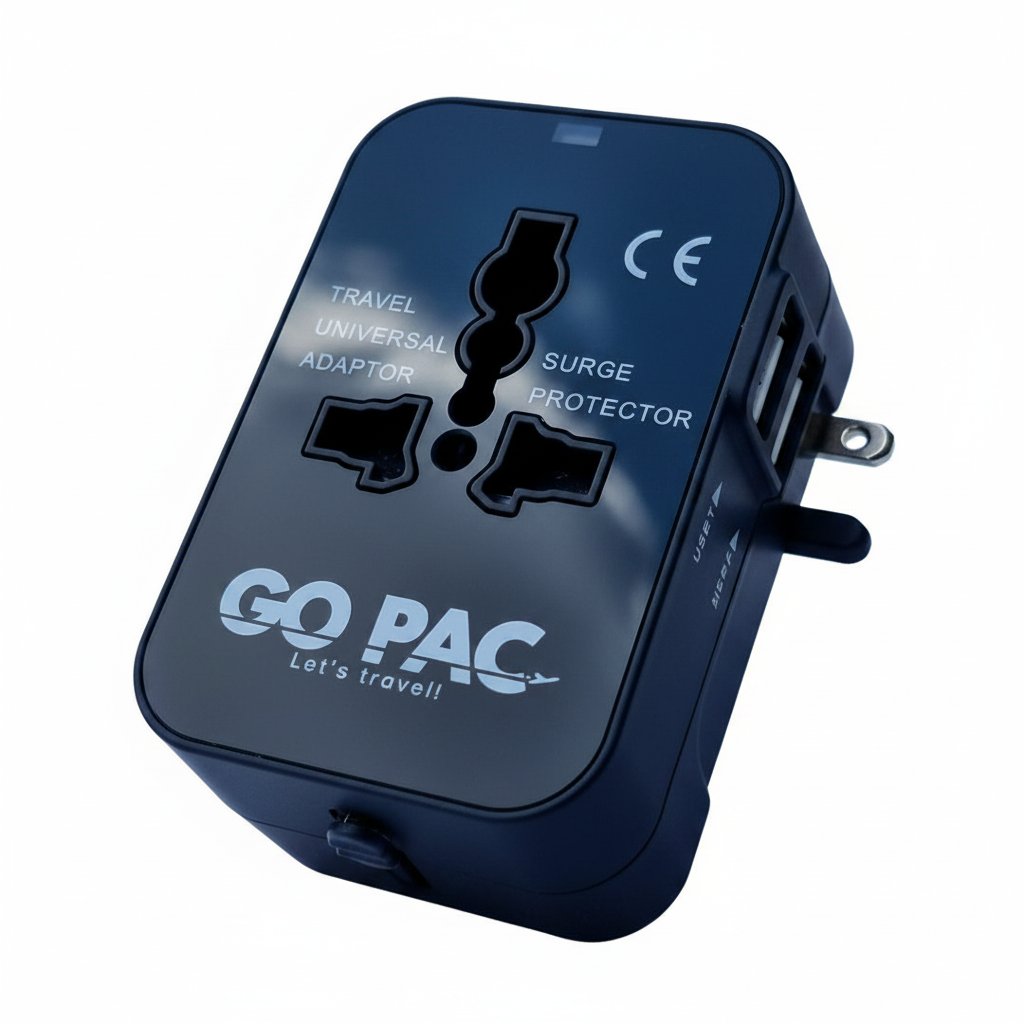
GO PAC Travel Plug Adapter The one we sell
Whatever you buy, ours or anyone else's, check the maximum rating in amps or watts shown on the adapter before you use it with anything that heats up.
View the GO PAC adapter, £14.99 ✦Common questions
No. It changes the shape of the plug so it fits the socket. Electrical Safety First advises that if the supply voltage is different, a voltage transformer or converter is needed unless the appliance or its power supply is dual voltage rated.
Look for an INPUT marking on the appliance or its power supply. Electrical Safety First gives the example INPUT: 110-240V, meaning it works with any supply between 110V and 240V. Most phone and laptop chargers are dual voltage. Many heating appliances are not.
Only if it is dual voltage rated for that country and it sits within the adapter maximum power rating, which is printed in amps or watts on the adapter. Otherwise you need a transformer or converter, not an adapter.
Type G, the three rectangular pin plug. Ireland, Malta, Cyprus, Singapore, Hong Kong and the UAE use it too, so a UK plug fits those sockets as it is.
Keep reading
Safety guidance on this page is summarised from Electrical Safety First, checked 25 September 2026. It is general information, not a substitute for the instructions supplied with your own appliance.